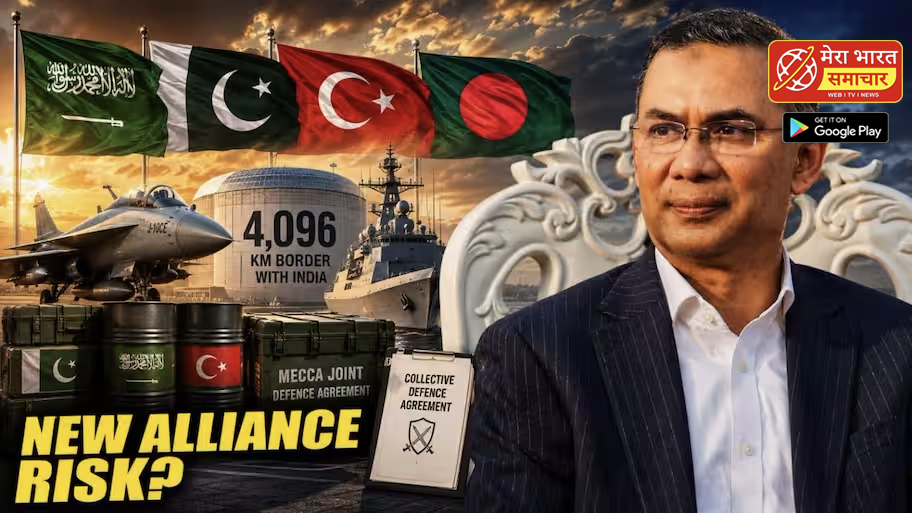
India’s eastern security flank could face a new strategic complication if Bangladesh joins the Mecca Joint Defence Agreement, bringing Dhaka into a Pakistan-linked collective defence framework while Pakistan already sits on India’s western border. Bangladesh has not yet joined the pact and says it has not received a formal invitation. But Foreign Minister Khalilur Rahman has told Parliament that Dhaka would consider membership positively if invited, while State Minister for Foreign Affairs Humaiun Kobir said there was no inherent risk in joining.
Key highlights
Bangladesh says it would consider joining the pact with Pakistan, Saudi Arabia and Turkey if invited.
Pakistan and Bangladesh together would place the collective-security arrangement on both sides of India.
Dhaka is also negotiating with China for J-10CE fighter jets, adding another layer to its defence ties.
Bangladesh shares a roughly 4,096-km border with India, making any strategic realignment especially significant for New Delhi.
What is Mecca Joint Defence Agreement?
The development matters because the Mecca Joint Defence Agreement is built around a collective-security principle: an armed attack against one member is to be regarded as an attack against all.
Saudi Arabia, Pakistan and Turkey signed the agreement in Mecca on August 7. Its expansion to Bangladesh could therefore alter the strategic calculations surrounding India, even though the publicly available text does not establish that Dhaka would automatically enter any future India-Pakistan conflict.
The two-front nightmare?
For New Delhi, geography is central to the concern. Bangladesh shares around 4,096 km of border with India, while Pakistan remains India’s principal military adversary on the western front.
Bangladesh joining a security framework that includes Pakistan would not automatically make Dhaka hostile to India. However, it could create a new layer of military and diplomatic coordination involving one of India’s immediate neighbours.
The Beijing factor
The picture becomes more complicated because of China’s growing defence relationship with Bangladesh. Dhaka is negotiating with Beijing over J-10CE fighter jets and attack helicopters, while China has supplied Bangladesh with warships, tanks, missiles and combat aircraft.
That means Bangladesh could potentially deepen defence links with China while joining a pact involving Pakistan, Saudi Arabia and NATO member Turkey, all while maintaining its existing economic and diplomatic relationship with India.
What next?
India has so far kept its public response measured. The Ministry of External Affairs has said New Delhi is closely following developments affecting India’s security and will take necessary measures to protect its interests.
The next major question is whether Saudi Arabia, Pakistan and Turkey formally invite Bangladesh. If they do, the terms of membership and especially how the pact’s collective-defence clause would operate could determine whether this becomes a symbolic partnership or a more consequential security bloc in South Asia.