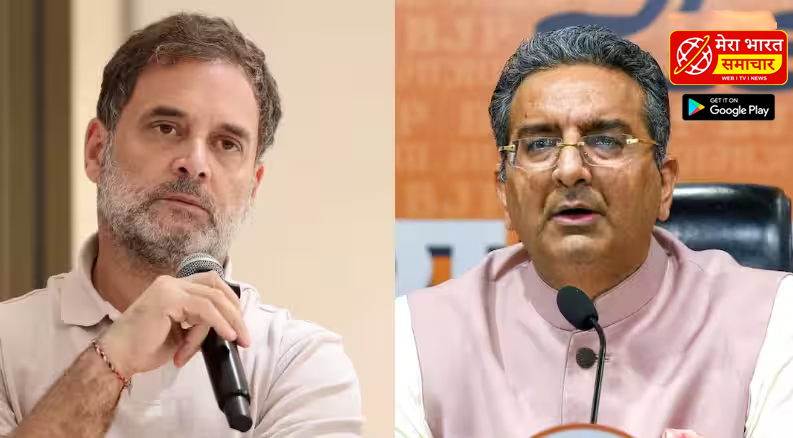
The Bharatiya Janata Party (BJP) on Thursday intensified its attack on Congress leader Rahul Gandhi, with party spokesperson Gaurav Bhatia calling the Leader of the Opposition in the Lok Sabha a “symbol of anarchy” following the Supreme Court’s observations on protests held on its premises.
Addressing a press conference, Bhatia accused Gandhi of undermining constitutional institutions and argued that the right to protest did not permit political leaders to cross legal or constitutional boundaries. The BJP’s remarks came after the Supreme Court made observations regarding Gandhi’s march to the top court and the protest held on its premises on Monday. Chief Justice of India Surya Kant said, “Nobody can browbeat the judiciary.”
The court issued notices on the petitions before it, while clarifying that issuing notice did not amount to condoning the conduct of the political leaders.
BJP Targets Rahul
Referring to the Supreme Court proceedings, Bhatia said Gandhi’s conduct was inappropriate for someone holding the position of Leader of the Opposition. “Rahul Gandhi has become the very embodiment of anarchy in Indian democracy. I would like to present some facts before you, particularly in light of the hearing held in the Supreme Court today,” he said, as per reports.
“We all know that Rahul Gandhi is the Leader of the Opposition, and people across the country consider it unfortunate that such an anarchic, immature and irresponsible person, who is ignorant of the Constitution, holds this position,” Bhatia added.
‘Right To Protest’
Bhatia argued that while the right to protest was a fundamental right, it could not be used to justify disorderly conduct or slogans at any location, including court premises.
“First, I say this with full responsibility: read the Constitution. The right to protest is your fundamental right. But does the right to protest allow anyone to cross its limits, go beyond the boundaries of the Constitution, and engage in hooliganism or raise slogans anywhere, whether in a public place, on a road or within the Supreme Court premises?” he said.
Bhatia, who said he had appeared before the Supreme Court as a senior advocate in connection with cases linked to the protests, questioned the decision to hold a demonstration at the court.
He maintained that courts were institutions responsible for delivering justice and should not become venues for political protests. He also raised concerns about crowds potentially gathering to target the judiciary, saying the judicial system enjoyed public trust.