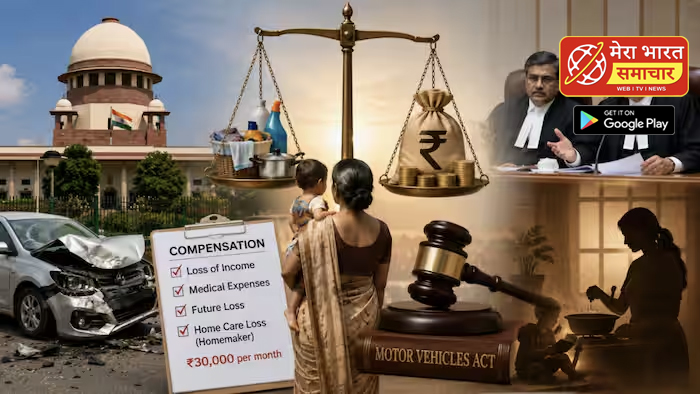
In a landmark decision concerning the elevation of the status of unpaid domestic labour, the Supreme Court of India has ruled that the loss of the services of the homemaker constitutes a new ground for motor accident compensation claims. Recognising the importance of the socio-economic contribution of the services rendered, the apex court has determined a bare minimum baseline financial valuation of a homemaker’s monthly income contribution at a bare minimum of Rs 30,000 per month.
A Division Bench composed of Justice Sanjay Karol and Justice N.K. Singh, while ruling on an appeal involving a motor vehicle accident case, made clear the importance of a homemaker in society:
“Also, the homemaker not only works for his/her own family but does contribute towards nation-building activities. We, therefore, have decided to lay down certain principles taking into account our view that a homemaker builds the nation. Therefore, we have fixed the monthly income for the loss of household care as a bare minimum of ₹30,000 per month.”
Delivering the landmark verdict, Justice Sanjay Karol stated the philosophy behind it:
“We are also of the view that a homemaker contributes to the development of human beings and the nation. A homemaker builds the nation. Therefore, we have laid down the principles, and viewing the housewife as a nation builder, we have fixed the monthly income for the loss of household care at a minimum of ₹30,000 per month.”
In expanding upon legal precedents in the domain, the apex court declared that “home care loss” will henceforth constitute a distinct head of damage, running parallel to the preexisting compensation heads set by the Supreme Court’s seminal judgment in Pranay Sethi.
Dismantling gender biases
The decision reflects yet another progressive step taken by the apex court toward dismantling long-held gender biases in financial actuarial evaluations.
“We hope and trust that the term ‘homemaker’ will now also achieve the identity of a ‘nation builder,'” Justice Karol observed during the course of hearings. The present judgment comes after an extremely important one in 2024 wherein the apex court had nullified insurance companies’ obsolete arguments regarding a homemaker’s “deemed income” being less than a “daily wage worker’s minimum baseline.”
Orders given on how to speed up disposal of motor accident litigation
Along with recognising the value of a homemaker, the division bench also issued several wide-ranging orders pertaining to speeding up pending motor accident claims and disposing of the backlog of cases pending before the Motor Accident Claims Tribunals (MACT).
Quoting Section 169 of the Motor Vehicles Act, which clearly specifies the need for a summary trial process in such cases, the bench observed that there was no option but to ensure strict compliance with the law “in letter and in spirit” without causing excruciating delay to aggrieved families.
To guarantee immediate field implementation, the Supreme Court has requested the Chief Justices of all High Courts across India to directly monitor MACT proceedings within their respective state jurisdictions, ensuring timely resolutions that actively integrate these newly established compensation principles.