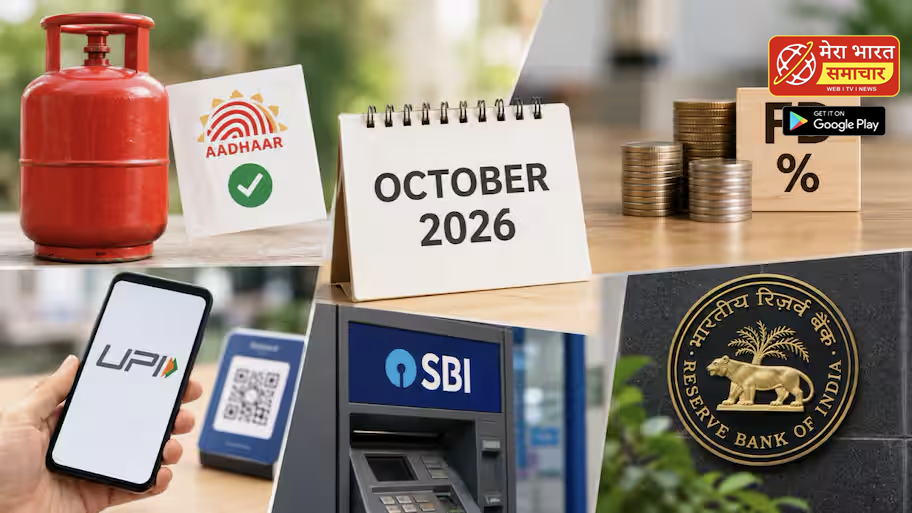
October is set to bring significant changes for merchants, households, and bank customers as several rules related to Fixed Deposits, ATM transactions, digital payments, and more are going to be revised.
Regulations around Bulk FDs, UPI merchant payments, SBI ATM transactions, and authentication of LPG cylinders are either going to change or meet their deadline. While stepping into the new month, know these important dates and changes that may affect your finances.
LPG cylinder authentication
To facilitate the supply of subsidized LPG to eligible households, it is now mandatory for domestic consumers to complete Biometric Aadhaar Authentication (BAA) to continue booking cooking gas refills at the regulated price from October 1, 2026.
Those who have already completed the process need not do it again.
The LPG supply would not halt for those who have not completed Aadhaar authentication; however, they would have to pay the higher market prices without subsidy instead of the regulated domestic price.
According to official data, 27.43 crore active domestic LPG consumers had completed biometric Aadhaar authentication as of September 19, which represents almost 90 per cent of the consumer base.
Authentication can be carried out during LPG cylinder delivery using a mobile application operated by the delivery personnel, at LPG distributor showrooms, or through the mobile applications of oil marketing companies, the government said.
Bulk FD rules
Reserve Bank of India’s (RBI) revised FD rules will be applicable from October 1, 2026. The changes extend to Bulk FDs as well.
Banks across all branches will have to provide the same rate of interest on deposits of the same amount made on the same day. This is to ensure that no customer in any part of the country faces discrimination by banks in terms of the rates offered.
Interest rates applicable on all deposits, including bulk deposits, must be disclosed by banks in advance to offer consistency to customers and help them make better decisions. For bulk deposits, banks are required to publish the interest rates on the website at 10:00 am, with a grace period of 10 minutes, every business day.
However, in the case of bulk deposits, RBI has offered greater flexibility to banks to offer different interest rates on bulk deposits depending on the liquidity risk as per the Liquidity Coverage Ratio (LCR) framework.
UPI MDR
UPI payments on specified merchant transactions above Rs 2,000 will attract Merchant Discount Rate (MDR) from October 15, 2026. MDR rates will not be the same for every merchant, as it will depend on the category of the business.
Person-to-person transactions and person-to-merchant transactions of Rs 2,000 or lower would attract zero MDR. Also, transactions covered under the zero-MDR framework for small merchants will remain free. This brings approximately 96 per cent of total P2M transactions outside the scope of MDR.
The Supreme Court has refused to put a stay on the decision after it was challenged through a Public Interest Litigation (PIL), while seeking responses from the Centre, RBI, NPCI, and other parties on the decision to allow a 0.4% MDR on specified transactions above Rs 2,000.
SBI ATM transactions
State Bank of India (SBI) has changed the number of free transactions available for salary package account holders who use their debit cards at other banks’ ATMs and Automated Deposit cum Withdrawal Machines (ADWMs).
The revised rules will be applicable from October 1, 2026.
Across all the SBI salary package account variants, the number of free transactions at other banks’ ATMs is reduced from ten to five in a month. This covers financial as well as non-financial transactions.
Basic Savings Bank Deposit (BSBD) account users will have four free cash withdrawals in a month, beyond which a charge of Rs 15 plus GST will be applicable.
It is to be noted that digital transactions would continue to remain free.
RBI MPC meet
The Reserve Bank of India’s (RBI) Monetary Policy Committee (MPC) meeting is going to be held from October 5 to October 7, in which the repo rate would be decided. Following RBI’s MPC meeting in August, the rate stands at 5.25 per cent. The October meet will decide whether the rates would change or remain the same.
The revised repo rate also affects the loan and FD rates offered by the banks. However, the actual impact on consumers depends on how the banks decide to navigate the changes in the lending and borrowing rates.