US President Donald Trump has again claimed control over maritime traffic through the Strait of Hormuz. He said the strategic waterway “belongs to the United States Navy and the United States of America”.
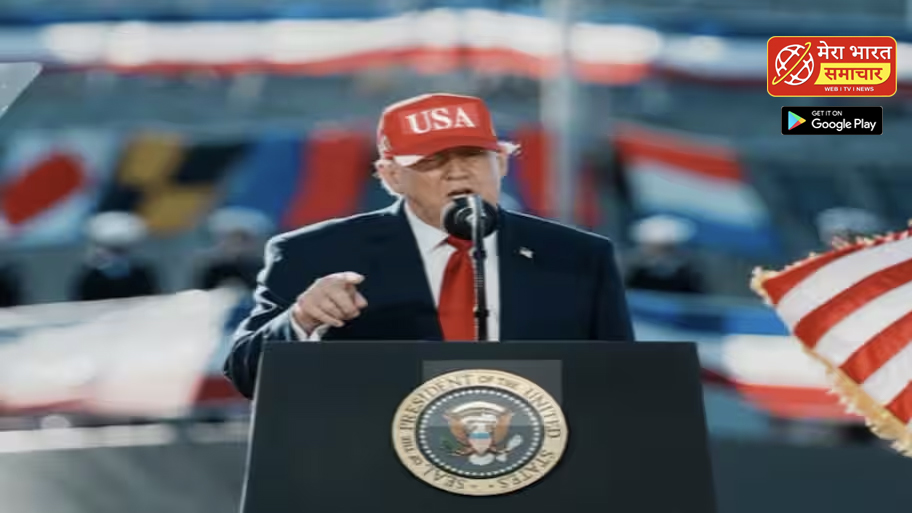
He made the statement during an event at Sparrows Point in Maryland on Tuesday (October 6), where he announced a new shipyard project aimed at increasing US naval production
Trump described the US naval presence around the waterway as one of the strongest blockades ever carried out. He said that the operation had stopped ships from entering Iranian waters and claimed oil shipments from outside Iran had recovered to levels “almost higher than they have ever been”.
“Nobody has ever seen a blockade like that, with no ships, zero, getting in,” he said.
He also described how US forces deal with vessels attempting to cross the area. “Every once in a while, they will do a run, and they will either hit the cabin if it has got oil, they will hit the cabin or they will hit the rudder. If it does not have oil, we just sink the ship,” he said.
Trump then made his claim about US ownership of the waterway.
“In other words, the Hormuz Strait belongs to the United States Navy and the United States of America. That’s where it belongs, and that’s where it is right now,” he said.
He has repeatedly claimed US control over shipping around the Strait of Hormuz during the confrontation with Iran. He has described the maritime operation as a blockade and said the US Navy has restricted Iranian vessels and ships heading towards Iranian ports.
At the Maryland event, Trump used another phrase for the operation. He called it a “wall of steel” rather than a blockade.
The International Maritime Organisation (IMO) has described the Strait of Hormuz as an international shipping route and has emphasised the right of transit passage under international law. In July, the IMO Council said transit passage through straits used for international navigation should not be threatened, denied or suspended. It also called for safe and unhindered navigation through the waterway.
The IMO says the existing traffic separation scheme in the Strait was proposed by Iran and Oman and adopted by the organisation in 1968. Its guidance identifies routes through Iranian and Omani waters for ships leaving the Gulf.
The Strait of Hormuz has been a major route for energy shipments and has faced prolonged disruption during the US-Iran conflict. The IMO said in August that up to 400 ships carrying about 6,000 seafarers had been unable to leave the Persian Gulf safely since the conflict began. The organisation has repeatedly called for freedom of navigation and protection of civilian crews operating around the Strait.
Trump says Iran’s military has been weakened
The president also used the Maryland speech to make new claims about Iran’s military capability.
“We are doing extremely well in the Islamic Republic of Iran, very well. They have no military. It’s shot; the whole place is shot,” he said.
He described the country as “the bully of the Middle East” and said it was no longer in the same position. Trump then said that the United States still had to finish its campaign against Iran.
“We have to finish up. And it’s only a question of which way do we want to do it, the nice way or the not-so-nice way? And pretty soon you will find out,” he said.
He also said that the US Navy was working to prevent Tehran from obtaining a nuclear weapon.
Shipyard announcement in Maryland
Trump’s statements on Iran and the Strait of Hormuz came during an event for a new defence shipyard at Sparrows Point. Defence technology company Anduril has announced a $3.7 billion investment in the facility, along with a $2.9 billion US Navy contract. The combined investment is valued at up to $6.6 billion.
Named Arsenal-2, the proposed facility is expected to produce components for Virginia-class nuclear-powered attack submarines. Anduril said the project is expected to create about 3,100 jobs and become operational by the end of the decade.
The company is also building another facility in Ohio for autonomous combat drones and a separate plant in California for submarine components.
Trump used the shipyard announcement to speak about America’s naval strength.
“With the help of everyone here today, America is going to remain the undisputed naval superpower of the world,” he said.